I'm making summer rolls today.
To be specific, shrimp summer rolls.
And you must be asking me,
"Rosie, what's a summer roll?
And how is it different from, say,
an egg roll, or a spring roll?"
I'll try to explain as best I can.
An egg roll is usually a savory wheat flour roll (made with egg) filled with shredded cabbage, pork, and other fillings (including thin strips of cooked shredded egg), and fried in hot oil. The egg roll wrapper is a thick wrapper and is heartier than a spring roll. Here's my egg roll recipe, in case you're interested. It's worth a click on the link.


A spring roll is made of rice paper filled with vegetables and meat, rolled into a cylinder, and fried.
Spring rolls have a thin, almost translucent wrapper.A summer roll is a fresh spring roll, kind of like a salad roll, unfried, and wrapped in parchment-thin rice paper.
At least, those are my definitions, but what do I know?
Then I read this:
Thi H. Nguyen:
I grew up eating spring/summer rolls, and many other kinds of rolls as well.
I eat lots of goi cuon (unfried rice paper rolls that are often
translated as salad or summer rolls) cha gio (fried rice paper rolls
often referred to as Vietnamese spring rolls)
All righty then.

As I said, one might call these "salad" rolls. Because they're filled with salad fixin's.

My salad fixin's include:
julienned carrots, cucumbers, red peppers, scallions, mint, and basil.
Not shown: my assorted greens from the garden - a tender, young, leafy mixture of salad/mesclun greens. If you don't grow your own greens, use a soft lettuce leaf like bibb, butterhead, arugula, oak leaf, or spinach.
Not shown: cooked shrimp, sliced.
Other fillings you might consider: assorted sprouts, radishes, avocado, rice noodles, shredded cabbage, mushrooms, tofu, cilantro, crab meat, bamboo shoots, water chestnuts.
It's up to you!

You also need some sushi rice. And some sushi vinegar.
Sushi rice is a short grain white rice containing a high percentage of starch which makes the grains sticky and perfect for sushi rolls. Regular white rice has been milled and processed, so it doesn't become as sticky when cooked.
Which brings me to sushi and sashimi. What's the difference? Sushi is made up of a combination of ingredients, most notably nori, or seaweed, with the common thread being rice dressed with vinegar. Sushi always has rice. Sashimi is thinly sliced raw seafood that's often used in sushi rolls.
To prepare the rice, I followed the directions on the container. I rinsed 1 cup rice in a strainer until the water ran clear, drained it, then put it in a pot with 1 1/4 cups water. I brought it to a boil, then reduced the heat, covered, and simmered for 15-20 minutes. Ended up with about 3 cups cooked rice. Removed it from the heat and let it stand for 10 minutes. Then I stirred in 3-4 tablespoons of the rice vinegar.

Dipping sauces are a must.
Here are just two to get you started:
Sauce #1 (left):
juice of 1 lime
1 TB soy sauce
1/4 tsp minced garlic
1 TB rice vinegar
1 TB honey
1 TB finely chopped cucumber
1 TB chopped toasted peanuts
1/2 tsp red pepper flakes
1 TB sliced scallions
Mix all together.
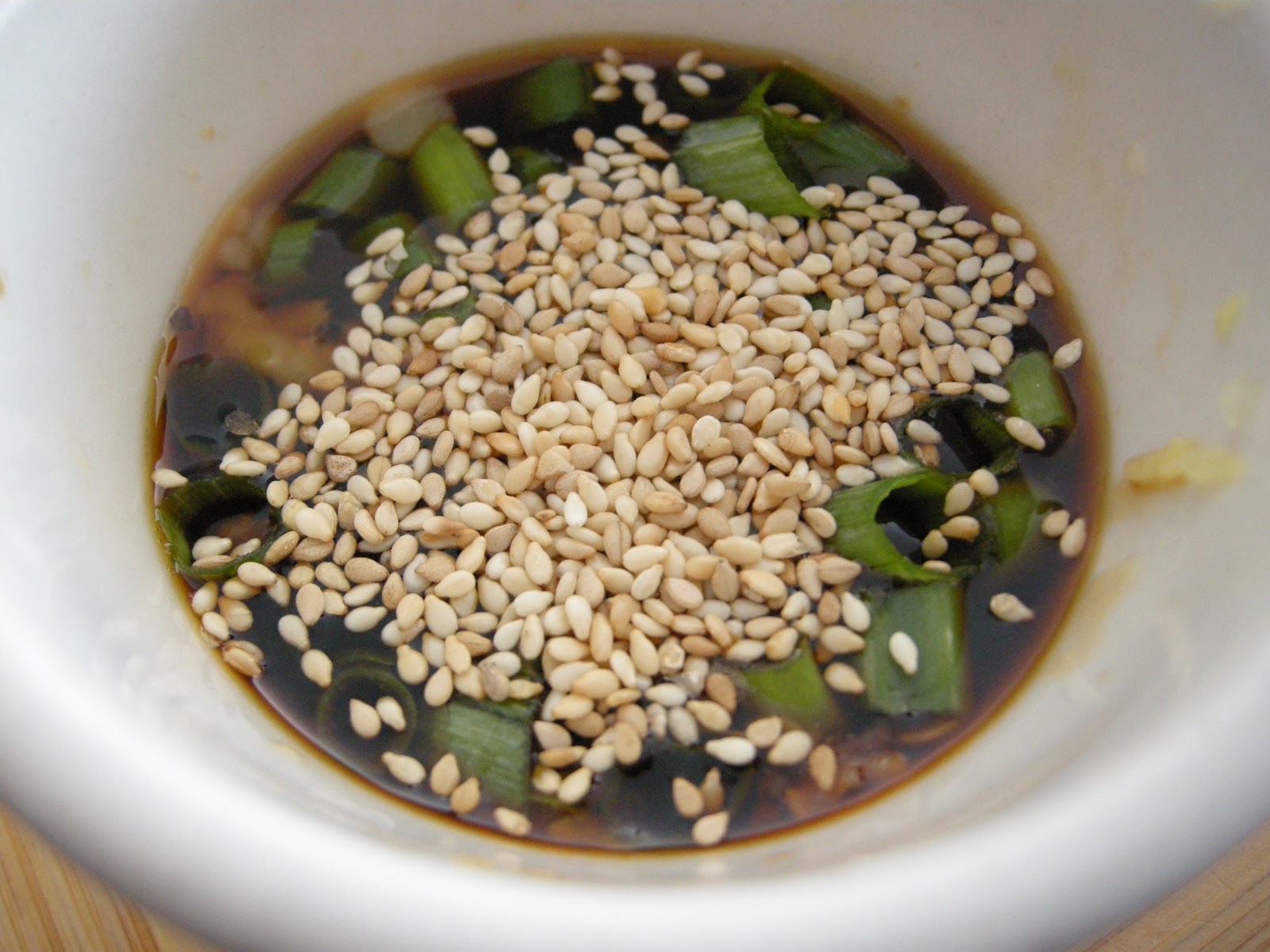
Sauce #2 (right):
juice from 1-inch cube of ginger
(I buy fresh ginger, cut it into 1-inch cubes, and freeze it. When I need ginger juice, I nuke a cube for about 20-25 seconds and put it through a garlic press. It's extremely hard to get juice from fresh ginger.)
1 garlic clove, minced
1 TB rice vinegar
1 tsp hoisin sauce
1 TB Thai chili sauce
1 TB soy sauce
1/2 tsp sesame oil
1 tsp toasted sesame seeds
1 TB sliced scallions
Mix all together.

For my wrappers, I use this rice paper.
From Andrea Nguyen, who KNOWS:
Rice paper used for Vietnamese food is
traditionally made from just rice, water, and salt. They are one of the
unique aspects of Vietnamese cooking and dining, and food wrapped up in
sheaths of translucent rice paper is utterly charming. Aside from
looking pretty and holding a bunch of goodies together, they contribute
chewy texture and a slight tang to whatever they encase.
Basically, rice paper is a thin steamed rice crepe (or sheet, as some
people call them) that has been dried. Traditionally, rice paper gets
dried on bamboo mats or stretchers of sorts, which explains why they
have a woven, rattanlike pattern. Rice paper is a great way to store
rice for a long time and it is convenient too. Right before using, it is
rehydrated and softened in warm or hot water. Vietnamese rice paper is a
cooked ingredient and once rehydrated, it can be eaten as is or fried.
It is not for baking so don't think it can be used like phyllo pastry!
See how thin it is?
Now, let's start rolling.

Pour some warm water in a plate
and set one sheet of rice paper in the water.
Rice paper, as you can see, is very delicate.
It doesn't need long in the water to soften, maybe 20-30 seconds.
Long enough to make it pliable.
Any longer, it will break down,
you'll have a gelatinous mess,
and won't be able to roll it at all.
you'll have a gelatinous mess,
and won't be able to roll it at all.
First, I put down some of the tender greens,
Then I added a layer of sticky, vinegared, sushi rice.
And then a layer of sliced, cooked shrimp.

Now, add on your julienned vegetables.

And your julienned herbs.
I used mint and basil.
I used mint and basil.

Working quickly, roll up the paper.
It doesn't have to be perfect.
Obviously.
Obviously.

And serve.

I like to slice the rolls on the diagonal.
For mouth-sized bites.
For mouth-sized bites.

Dip away!


I also made a third sauce.
Very simple.
Equal amounts honey and rice vinegar,
then add in some sliced scallions,
finely chopped cucumbers,
chopped toasted peanuts,
and red pepper flakes.
All to taste.


Very simple.
Equal amounts honey and rice vinegar,
then add in some sliced scallions,
finely chopped cucumbers,
chopped toasted peanuts,
and red pepper flakes.
All to taste.


Enjoy!
And just give me some time to practice.
I'll be creating kaleidoscopic visions in no time!