Showing posts with label Chef Andy Montero. Show all posts

Saturday, November 18, 2017

Seafood Series At The NC Aquarium. Lionfish!

Rosie is happy.
After a two-year plus hiatus, the seafood series cooking classes are finally back at the NC Aquarium!


Tuesday, November 14, 2017, Chef Andy Montero, of Montero's Restaurant in Elizabeth City, was on hand for the opening class.

Our featured fish today?  Lionfish!

Normally, the presenting chefs provide the seafood for our classes.  Not so today.  The intrepid dive team of the NC Aquarium provided the lionfish for today's cooking class.

(Stock photo)


First some lionfish information.  The lionfish is an invasive species here on the Outer Banks - it is not native to the ecosystem here. It has been introduced into the environment and is a threat to  existing species in our Atlantic waters.  The lionfish is indigenous to the Indo-Pacific area and was introduced to Florida waters in the early 1990s, perhaps released by pet stores or aquarium owners during Hurricane Andrew in 1992, and is spreading rapidly throughout the Caribbean and Atlantic regions.  It is an invasive carnivorous predator which can harm our ecosystems and negatively impact our native fish production.  The lionfish, since it's non-native to our waters, has few predators and is at the top of the food chain.  It's a successful invader with venomous spines; it's an efficient predator; it is a competitor to many NC fishery species; it has rapid growth and high reproductive rates.  Combined with the impacts of preexisting conditions, for example over-fishing, the lionfish is in a position to cause substantial damages in coral-reef communities.  Feeding on small crustaceans and fish, it can cause damage to our native species, particularly snapper and grouper.

 It is doubtful we can ever eradicate the lionfish population in invaded areas, so the question is - how do we manage their population?  The consensus is - if you can't beat 'em, eat 'em.  Soooo, the dive team at the NC aquarium ventured out to wrecks off Hatteras inlet (This is the Graveyard of the Atlantic, and for good reason.) and came back with the booty.  The dive team investigated three shipwrecks off Cape Hatteras - the Tarpon, The Dixie Arrow, and the Keshena.  They returned with almost 100 lionfish - from 5" to 18" which they dressed and filleted, and brought to Chef Montero for our class.

(stock photo)
 
In cleaning lionfish, it is advisable to wear puncture-proof gloves.  The dorsal spines are venomous.  Although not fatal, the spines can deliver painful stings causing a variety of symptoms - pain, swelling, tingling, headache, chills, cramps, nausea, and, in extreme cases, even paralysis and seizures.

 (stock photo)

The majority of lionfish were found by the divers on the Tarpon, a World War II submarine which foundered while under tow in 1957 and now rests in water 140 feet deep.  The other two dive sites were the Dixie Arrow, sunk by a German U-boat in 1942 and resting in 90 feet of water,  and the Keshena, a tug which was sunk by a mine (actually friendly fire, the Hatteras minefield being set to provide relief from attacking U-boats) in 1942.

Now, let's EAT!
(Recipes by Chef Montero.)


For our first presentation, the fillets were rubbed with a tangy and salty red miso paste (fermented soy beans) and simply seared in vegetable oil. These were served on a bed of cole slaw with a quick-chi dressing.  (Quick-chi, as in non-fermented, as opposed to kimchi, which is fermented.)


 Cole slaw with quick-chi dressing
shredded cabbage
shredded carrots
Dressing
7 TB sriracha
1/2 cup fish sauce
3/4 cup rice wine vinegar
1/2 cup sweet and spicy Thai chili sauce
2 tsp lime juice
2 tsp lemon juice
4 tsp sesame oil
Mix together all ingredients and toss with cabbage and carrots to coat evenly.
(Dressing can be stored up to 2 weeks in fridge.)


Our next preparation was baked lionfish fillets, simply seasoned with salt and pepper.
These were topped with a fresh herb aioli or mayonnaise.


Fresh herb mayo
1/2 cup mayonnaise
1 TB minced yellow onion, or shallot
1 TB minced chives
1 TB minced parsley
1 TB minced basil
1/4 tsp black pepper
pinch granulated garlic

Combine all ingredients.
Garnish cooked fish fillet with mayo before service.

This aioli with fresh herbs needs to be used up.  It's not something that keeps in the fridge.


Our final preparation was a Caribbean Ceviche.
The fish is chemically "cooked" by the acid, in this case lime juice.

Caribbean Ceviche
1/2 cup diced red onion
3/4 cup chopped cilantro
1 cup diced tomato
1 cup diced pineapple
2 jalapenos, minced
3 TB sugar
4 cups lime juice
(Yes...  4 cups.)
Combine all ingredients.
Marinate up to 2 1/2 pounds of seafood for 45 minutes.


Now, if only I had my own personal dive team to go out a spear lionfish for me. 


Monday, April 28, 2014

The Hawthornes Attend Cooking Class At The North Carolina Aquarium With Chef Andy Montero.

As you know, I love our cooking classes
at the North Carolina Aquarium on Roanoke Island.

I always learn something.

Last week, Chef Andy Montero
 of Montero's Restaurant in Elizabeth City, NC,
was the presenter.

I've always loved his presentations.
Chef Montero has a big personality,
enjoys what he does,
and always asks for audience input.
He's fun to watch.
He's entertaining.
He's informative.
He's an educamation.

Before any presentation,
Aquarium Instructor Beth Wilcox
always explains about whatever fish we're having.
Today, it's yellowfin tuna.
And I loves me some tuna.
Yellowfin tuna is the top tuna harvested by US fishermen in the Atlantic.  It's a fast-growing fish that reproduces at an early age, producing millions of offspring - a necessary trait to help them withstand heavy fishing.  As one of the top three seafood items sold in the US, tuna is in high demand and many populations are declining.  Yellowfin is caught with many types of gear - troll, pole, longline, and purse seine gear; however, not all yellowfin fisheries use ocean-friendly methods. The best choice is yellowfin caught by troll or pole - that is the most sustainable option.  With pole or troll gear, there is little or no bycatch.  Longlines and seines result in large quantities of bycatch, including threatened or endangered species such as sea turtles, bluefin tuna, billfish, sharks, and seabirds.  In US longline fisheries, as opposed to international fisheries, fishermen abide by a number of measures that reduce the fisheries' impact on other species.  For example,the mandatory use of special hooks and baits is required to reduce bycatch.  Also, the fisherman carry gear and are trained in handling techniques to dehook species and safely return them to the water.  US fisheries are monitored for bycatch ensuring the fishermen responsibly harvest yellowfin.  Sustainable seafood is what it's all about.


Our first offering is Tuna Poke, pronounced POH-kay),
a Hawaiian dish of raw fish doused in seasonings.

Tuna Poke
4 oz. tuna, fresh, raw, small dice
1 TB Sushi sauce
dash sesame oil
1/8 tsp sesame seed, white
1/8 tsp sesame seed, black
1/4 tsp ginger, minced
1 tsp chives, minced (Reserve tops for garnish.)
1/2 tsp lime juice
pita points

Mix all ingredients except pita points and chive tops.
Mix well to incorporate flavors.
Serve atop pita points and garish with chive tops.
Serve immediately.

I loved this.
So much so, that after eating my allotted two tuna pokes
that were served to me,
and staring at the platter in front of Chef Montero
containing the remaining 5 tuna pokes
while he worked on the next dishes,
I finally got up in the middle of class,
walked up front and
announced to my classmates
that they all had their chance to get one
and I was taking one.
After that, three more women got up and grabbed a poke.

I learned something new - Sushi Sauce.
Chef Montero recommends Yoma Brand, not Kikkoman.
I haven't seen this in stores,
but I'll look for it next time I'm at the Teeter or Fresh Market.
At any rate, both Mr. Hawthorne and I
tasted the Sushi Sauce right out of the squeeze bottle
and we can duplicate it -
Tamari, mirin, sake, honey.
I meant to ask Chef Montero what kind of pita crisps those are.
They're really good.
I'll have to look for them too.

ETA: Chef Montero answered my email.
The pits are Kontos brand pita rounds.

Remember I said there were five remaining pokes
and I grabbed one and three others came up to grab a poke.
Why do people always leave one appetizer or cookie on a platter?
Look at the poor sad little poke on the platter up there.
Well ...
when I went up to get my plate of bronzed tuna,
 citrus slaw, and couscous ...
... you better believed I snagged that little bugger!

I loved the slaw.
Anytime I have a slaw without mayonnaise
I am happy.
This was tangy and refreshing.

Citrus Slaw
1/4 head cabbage, shredded
1 tsp each lime, lemon, and orange zest
4 TB orange/lime/lemon juice mixture
2 TB honey
1/8 cup vegetable oil
1/4 cup red onion, minced
2 tsp ginger, minced
pinch granulated garlic
salt and pepper to taste


The bronzed tuna was coated in equal amounts 
of blackening seasoning and brown sugar.
It was seared in a minimal amount of oil in a sauté pan.

Hot vegetable stock was poured over
couscous, shredded carrot, sliced grape tomatoes,
sliced red onion, granulated garlic, salt and pepper.
Cover for 15 minutes or so.
Fluff with fork and sprinkle fresh oregano over top.

Me?
I'd throw some butter on it!

Thank you Chef Montero
for an informative and enjoyable presentation and great food!


As always, the turtles are happy to see me.


Here are some more denizens of the aquarium.


If  you have a chance,

Friday, March 16, 2012

The Hawthornes Attend Cooking Class At The North Carolina Aquarium.

On Wednesday, the Hawthornes and Glowria headed to the North Carolina Aquarium on Roanoke Island for another cooking class. Poor Zelda, who usually rides with us, had issues with the DMV, which is in Manteo, and had driven herself. A DMV scenario never turns out well. Zelda, I wish you the best, but the last time I had an issue with the DMV, when I went to renew my license, which I've been doing with no problems since 1984, I was forced to drive to the Social Security Office in Elizabeth City the next day and CHANGE MY LAST NAME. I've been fine with banks, credit cards, AND THE IRS, but it wasn't GOOD ENOUGH for the North Carolina Division of Motor Vehicles. I spit in your general direction, NCDMV. My rant over with, the Hawthornes and Glowria get to our destination, the aquarium in Manteo.
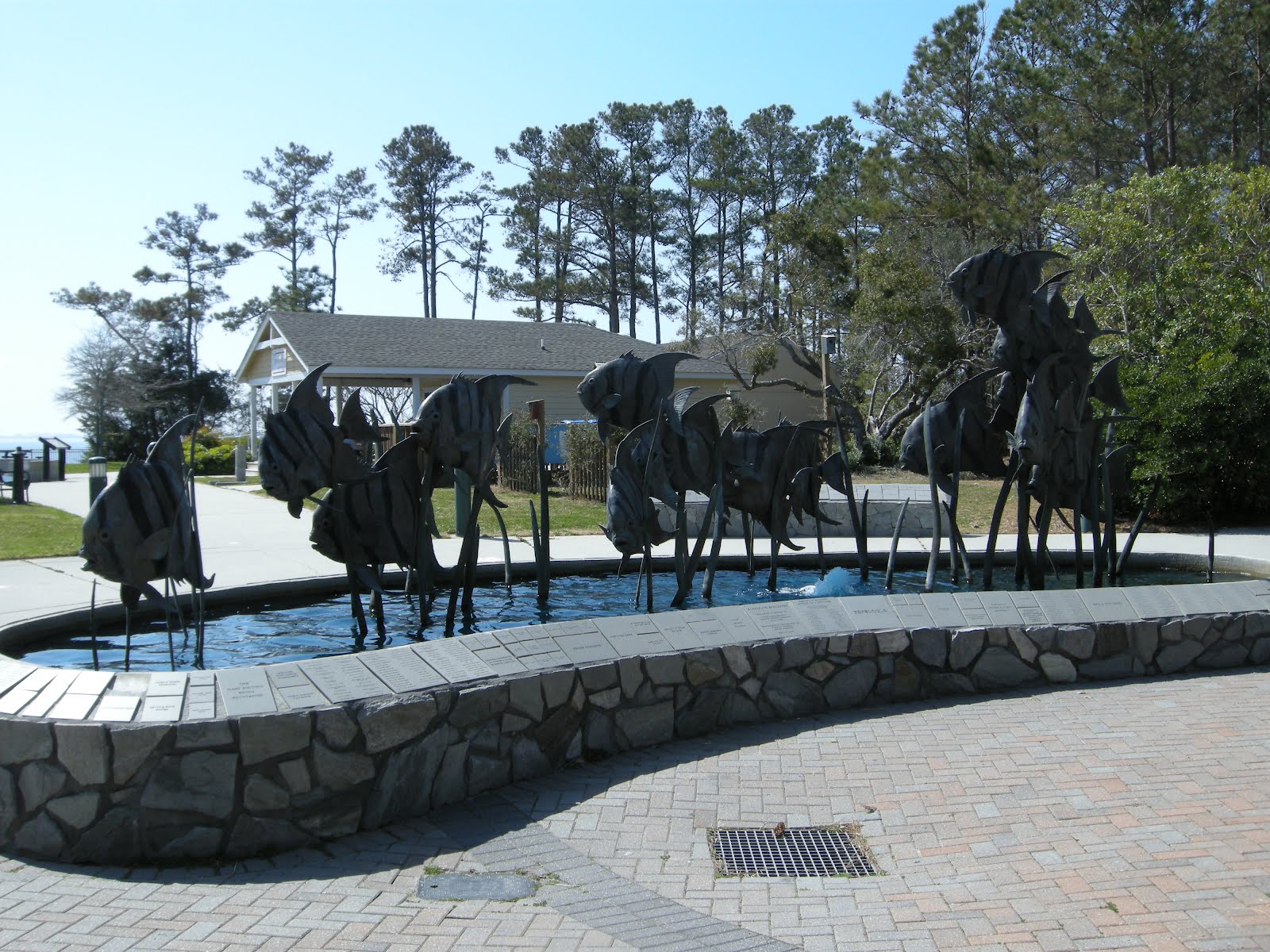
Fishies sculpture outside the aquarium. The otters, Nelson and Harriet, were so glad to see me again.
I don't usually see both alligators out sunning. Deborah is hiding in the back. This was a treat.
They seem to be smiling.
Raoul, particularly, seems to be comfortable and relaxed.
Today's class is brought to you by Chef Andy Montero of Montero's Restaurant in Elizabeth City, NC. Chef Montero is preparing swordfish steaks with a toasted tomato beurre blanc sauce, broccolini , and smoked Gouda mac & cheese. Hmm. This is going to be tough. I'm not that crazy about swordfish, broccolini isn't worth the trouble, and I've never been a fan of mac & cheese. I know. I know. Not a fan of the mac. I don't care for hot dogs or apple pie either. Mr. Hawthorne thinks I'm peculiar. I guess I would be the odd branch in the tree. Have I lost total credibility now? We always get a lesson in whatever piscine critter we're eating by one of the knowledgeable aquarium program directors. Liz explained that after World War II, the swordfish was overfished and it's taken to the mid to late 90s to get the population back up. The swordfish is a strong, powerful fish. When hooked, they have been know to quickly dive to the bottom and impale their swords into the sand up to their eyes. Fishing regulations today call for a size minimum of 4 feet and only one swordfish per day. The record size for a swordfish caught in North Carolina is 441 pounds, in 1979. Swordfish tend to have a high mercury content so it is recommended no more than one serving per week. Also children and pregnant women should avoid swordfish. Chef Montero then explained about the habits of the swordfish jumping, or breaching, the water. The jumping is a technique the swordfish uses to try to get rid of hangers-on that have attached themselves to the swordfish's thick, leathery skin. Also, Chef Montero explained, as a predator, this fish has a tendency to pick up parasites. Chef Montero assured us this fish was parasite-free. Num Yum! As I said, I'm not particularly fond of swordfish. It's an oily fish and it has a huge bloodline going down the middle.
Our fish today was locally caught on a long line. Chef Montero cut the steaks in half and seasoned them with salt and pepper. He seared the filets in medium hot skillets in oil then removed to pans and finished off in a 350 degree oven.
Save the pans to make the sauce in. The goodie bits, or fond, have all the concentrated flavor in them.
Roasted Tomato Beurre Blanc 1/2 cup cherry tomatoes, halved extra virgin olive oil, as needed salt and pepper, to taste 1/4 cup diced onion handful of portabella mushrooms, sliced 1 tsp garlic, minced 1/2 cup white wine 3/4 cup chicken or vegetable stock 2 TB butter, diced 1 TB fresh herbs - basil chiffonade fresh lemon zest Heat oven to 375 degrees. Toss the tomatoes, extra virgin olive oil, and salt and pepper and lay on a cookie sheet, flesh side up. This way, you save flavor and avoid a mess. Roast about 15 minutes or until golden brown. Set tomatoes aside, including any liquids rendered, for later use. In a skillet (preferably the one with the goodie bits), saute the onions in a small amount of oil over medium high heat. As the onions soften, add the garlic and mushrooms and saute about 2 more minutes. Deglaze the pan with the wine and reduce by half. Add the stock and bring to a simmer. Simmer until reduced by half. Reduce heat and slowly stir in the butter to emulsify. Add the fresh herbs and some lemon zest and serve over swordfish. Chef Montero's emphasis is on technique. For example, fresh herbs are added at the end, immediately before serving. Dry herbs are added in the beginning. At this point Montero went into a "love letter" analogy about dry and fresh herbs. It seemed this explanation, offered to his future future wife when he was in culinary school, is what made her decide to go out with him. Now, I'm going to ramble a bit now, as I try to get the analogy right, so bear with me. Dried herbs are like a love letter. You send the letter, scented with perfume. She opens it up and the perfume is released. Dried herbs need heat and moisture to release their essential oils. Therefore, you add dried herbs at the beginning, so the moisture and heat can do their magic. Maybe, I missed a step, but stay with me. Suppose said suitor decided to bring fresh flowers instead of a perfumed love letter. And suppose the hapless suitor left said fresh flowers in the back seat of the car. On a hot day. With the windows closed. When he goes back to get his fresh flowers, they are drooping and lifeless from the heat. Moral: Add fresh herbs right before serving. They're at their peak then. Do not cook fresh herbs. Chef Montero is very personable and engaging and clearly comfortable talking about his passion. In fact, he teaches cooking classes at the restaurant, which I would highly recommend. He's very enthusiastic about his craft and it shows and overflows. Chef Montero and his staff are more than happy to have their guests, if they have certain dietary restrictions, bring their own items from home for Montero's to prepare for them. Chef Montero then explained about the technique of blanching, using the broccolini. Broccolini is similar to broccoli, but has longer, thinner stems, and more open florets. Let's just say, I'm not crazy about it. As for broccoli rabe, I don't even go there. Once was enough. To blanch a vegetable, drop it into salted simmering water for about 1 -2 minutes. Then submerge the vegetable in ice water to stop the cooking and set the color and texture. Next, Chef Montero spread the broccolini out on a sheet pan, topped it with butter and salt and pepper. This went into a 375 convection oven until tender. By blanching, or parboiling, the broccolini, the vegetable cooks more evenly. Without blanching, the stems would be undercooked and the florets overcooked. Blanching evens everything out. Let's turn our attention to the Smoked Gouda Mac & Cheese. As I said, I've never been a fan of mac & cheese. I never had it growing up as a child and I never saw a reason to have it as an adult. I have made it before. Actually, I made Pauler Deen's version years ago, since I figured hers would be totally over the top. I like to cut through the facsimiles and get to the real deal. It was OK. Smoked Gouda Mac & Cheese 2 tsp oil 1/8 cup onions, diced 1 tsp garlic, minced 3 cups half and half 1 cup milk 1/2 cup cream cheese, softened 2 cups smoked Gouda, shredded 4 cups pasta, cooked, drained, room temperature salt and pepper Panko bread crumbs Parmesan cheese, grated Heat oven to 350 degrees. In a medium sauce pan, over medium heat, cook the onions in the oil until softened. Add the garlic and cook until tender. Add the cream and milk and bring to a simmer, stirring often. Once simmering, continue to cook for approximately 3 minutes, then reduce heat slightly. Stir in the cream cheese and whisk well to incorporate. Remove from heat and stir in the smoke Gouda until smooth. Stir in the pasta. Season with salt and pepper. Place the mac & cheese in a baking dish, top with panko and Parmesan and bake approximately 10 minutes or until golden brown. Again, Chef Montero talked about technique. For the sauce for the mac & cheese, he didn't want a thickening sauce, so he's not adding a roux. Cheese is going to thicken it a bit, plus the starch from the pasta will help thicken it. The cream cheese is a great stabilizer, it melts smoothly, and adds a nice base flavor. As for techniques, this sauce can easily be turned into a Bechamel Sauce by the addition of equal parts, by weight, of butter and flour. That's your basic roux. For a more robust sauce, cook the roux a bit darker and add in beef stock. For Cajun and Creole dishes, you want an even darker roux - a black, but not burned, roux. Chef Montero offered a short cut to the darker roux. Toast your flour in a 350 degree oven first, then make the roux. Be sure your oven is on bake, not convection.
Here's my dish. As I said at the beginning, swordfish is not my favorite. It's too oily and there's that bloodline. I don't even like the meat in close proximity to the blood line. That said, the swordfish was cooked perfectly and I liked the sauce.
Broccolini is not my favorite either, but I think Chef Montero chose this to explain about the blanching technique.
Of the three, my favorite was the mac & cheese. Go figger. Except I would have browned it on top more. Bottom line: Chef Montero is a dynamic personality and he's fun to watch and listen to. He's educational. He knows what he's doing. And he threw in a few jokes in there that Mr. Hawthorne and I caught, but I don't think the others did, because there was no response. One joke was about the length of his offset serrated knife- "13 inches to a man, 9 inches to a woman," and another one was about yet another technique - the basil chiffonade. "Anybody here go to Woodstock? Then you may know how to do this." Heh. I pay attention in class. Apparently nobody in our class went to Woodstock, except for Mr. Hawthorne and me. Just kidding. If Chef Montero had classes on the beach I'd go to them, instead of in Elizabeth City, an hour away, where it's not feasible for me to go to a 6PM cooking class which offers wine. Now, you don't know Glowria like we do. But she had company coming that afternoon and needed something to feed them. I saw her approach Chef Montero and actually ask him what he was going to do with the leftover mac & cheese. Honest to God. Chef Montero graciously offered the mac & cheese for Glow to take home. Glowria scurried about for a styrofoam take-out carton and finally came back with a zip-lock bag, into which she shoveled the mac & cheese. Then she started poking the cheese down in the bag with her fingers, stopping to lick her fingers.
Here's Zelda in the background, holding up Glowria's mac & cheese bag. I asked Glow on the way home if she was going to serve the macaroni from a serving dish or just cut off the tip of the bag and pipe it out.
Bye bye, Deborah. Buh bye, Raoul. See you later, alligators. Actually, I'll see you Monday for the next cooking class.
Bye bye, turtles.
Until next time, otters.